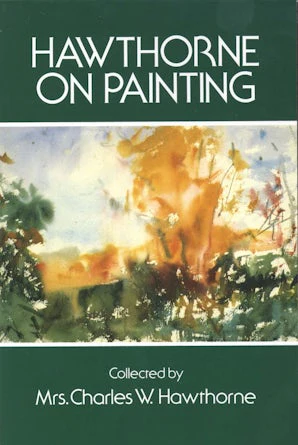
Hawthorne on Painting
Look around and select a subject that you can see painted. That will paint itself. Do the obvious thing before you do the superhuman thing.
It may have been accidental, but you knew enough to let this alone. The good painter is always making use of accidents.
Never try to repeat a success.
Swing a bigger brush — you don’t know what fun you are missing.
For 31 years, Charles Hawthorne spoke in this manner to students of his famous Cape Cod School of Art. The essence of that instruction has been collected from students’ notes and captured in this book, retaining the personal feeling and the sense of on-the-spot inspiration of the original classroom. Even though Hawthorne is addressing himself to specific problems in specific paintings, his comments are so revealing that they will be found applicable a hundred times to your own work.
The book is divided into sections on the outdoor model, still life, landscape, the indoor model, and watercolor. Each section begins with a concise essay and continues with comments on basic elements: general character, color, form, seeing, posture, etc. It is in the matter of color that students will especially feel themselves in the presence of a master guide and critic. Hawthorne’s ability to see color and, more important, to make the student see color, is a lesson that will aid student painters and anyone else interested in any phase of art.
Although it does not pretend to be a comprehensive or closely ordered course, this book does have much to offer. It also represents the artistic insight of one of the finest painter-teachers of the twentieth century.
"An excellent introduction for laymen and students alike." — Time
"To read these notes and comments … is in itself an education. One cannot help but gain great help." — School Arts
Product Information
Product Information
Shipping & Returns
Shipping & Returns
Description
Look around and select a subject that you can see painted. That will paint itself. Do the obvious thing before you do the superhuman thing.
It may have been accidental, but you knew enough to let this alone. The good painter is always making use of accidents.
Never try to repeat a success.
Swing a bigger brush — you don’t know what fun you are missing.
For 31 years, Charles Hawthorne spoke in this manner to students of his famous Cape Cod School of Art. The essence of that instruction has been collected from students’ notes and captured in this book, retaining the personal feeling and the sense of on-the-spot inspiration of the original classroom. Even though Hawthorne is addressing himself to specific problems in specific paintings, his comments are so revealing that they will be found applicable a hundred times to your own work.
The book is divided into sections on the outdoor model, still life, landscape, the indoor model, and watercolor. Each section begins with a concise essay and continues with comments on basic elements: general character, color, form, seeing, posture, etc. It is in the matter of color that students will especially feel themselves in the presence of a master guide and critic. Hawthorne’s ability to see color and, more important, to make the student see color, is a lesson that will aid student painters and anyone else interested in any phase of art.
Although it does not pretend to be a comprehensive or closely ordered course, this book does have much to offer. It also represents the artistic insight of one of the finest painter-teachers of the twentieth century.
"An excellent introduction for laymen and students alike." — Time
"To read these notes and comments … is in itself an education. One cannot help but gain great help." — School Arts