🚚 Free Worldwide Shipping on All Orders!Shop Now

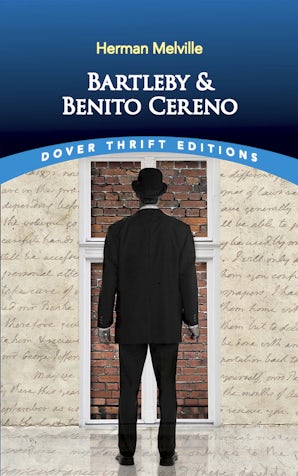
Bartleby and Benito Cereno
Herman Melville towers among American writers not only for his powerful novels, but also for the stirring novellas and short stories that flowed from his pen. Two of the most admired of these — "Bartleby" and "Benito Cereno" — first appeared as magazine pieces and were then published in 1856 as part of a collection of short stories entitled The Piazza Tales.
"Bartleby" (also known as "Bartleby the Scrivener") is an intriguing moral allegory set in the business world of mid-19th-century New York. A strange, enigmatic man employed as a clerk in a legal office, Bartleby forces his employer to come to grips with the most basic questions of human responsibility, and haunts the latter's conscience, even after Bartleby's dismissal.
"Benito Cereno," considered one of Melville's best short stories, deals with a bloody slave revolt on a Spanish vessel. A splendid parable of man's struggle against the forces of evil, the carefully developed and mysteriously guarded plot builds to a dramatic climax while revealing the horror and depravity of which man is capable.
Reprinted here from standard texts in a finely made, yet inexpensive new edition, these stories offer the general reader and students of Melville and American literature sterling examples of a literary giant at his story-telling best.
"Bartleby" (also known as "Bartleby the Scrivener") is an intriguing moral allegory set in the business world of mid-19th-century New York. A strange, enigmatic man employed as a clerk in a legal office, Bartleby forces his employer to come to grips with the most basic questions of human responsibility, and haunts the latter's conscience, even after Bartleby's dismissal.
"Benito Cereno," considered one of Melville's best short stories, deals with a bloody slave revolt on a Spanish vessel. A splendid parable of man's struggle against the forces of evil, the carefully developed and mysteriously guarded plot builds to a dramatic climax while revealing the horror and depravity of which man is capable.
Reprinted here from standard texts in a finely made, yet inexpensive new edition, these stories offer the general reader and students of Melville and American literature sterling examples of a literary giant at his story-telling best.
Reprint from The Piazza Tales, 1856.
$1.50
Original: $5.00
-70%Bartleby and Benito Cereno—
$5.00
$1.50Product Information
Product Information
Shipping & Returns
Shipping & Returns
Description
Herman Melville towers among American writers not only for his powerful novels, but also for the stirring novellas and short stories that flowed from his pen. Two of the most admired of these — "Bartleby" and "Benito Cereno" — first appeared as magazine pieces and were then published in 1856 as part of a collection of short stories entitled The Piazza Tales.
"Bartleby" (also known as "Bartleby the Scrivener") is an intriguing moral allegory set in the business world of mid-19th-century New York. A strange, enigmatic man employed as a clerk in a legal office, Bartleby forces his employer to come to grips with the most basic questions of human responsibility, and haunts the latter's conscience, even after Bartleby's dismissal.
"Benito Cereno," considered one of Melville's best short stories, deals with a bloody slave revolt on a Spanish vessel. A splendid parable of man's struggle against the forces of evil, the carefully developed and mysteriously guarded plot builds to a dramatic climax while revealing the horror and depravity of which man is capable.
Reprinted here from standard texts in a finely made, yet inexpensive new edition, these stories offer the general reader and students of Melville and American literature sterling examples of a literary giant at his story-telling best.
"Bartleby" (also known as "Bartleby the Scrivener") is an intriguing moral allegory set in the business world of mid-19th-century New York. A strange, enigmatic man employed as a clerk in a legal office, Bartleby forces his employer to come to grips with the most basic questions of human responsibility, and haunts the latter's conscience, even after Bartleby's dismissal.
"Benito Cereno," considered one of Melville's best short stories, deals with a bloody slave revolt on a Spanish vessel. A splendid parable of man's struggle against the forces of evil, the carefully developed and mysteriously guarded plot builds to a dramatic climax while revealing the horror and depravity of which man is capable.
Reprinted here from standard texts in a finely made, yet inexpensive new edition, these stories offer the general reader and students of Melville and American literature sterling examples of a literary giant at his story-telling best.
Reprint from The Piazza Tales, 1856.