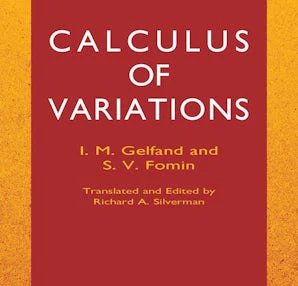

Calculus of Variations
The clarity of exposition makes this book easily accessible to anyone who has mastered first-year calculus with some exposure to ordinary differential equations. Physicists and engineers who find variational methods evasive at times will find this book particularly helpful.
"I regard this as a very useful book which I shall refer to frequently in the future." J. L. Synge, Bulletin of the American Mathematical Society.
Reprint of the 1952 edition.
Bonus Editorial Feature
Robert Weinstock: Mathematical Memories
Robert Weinstock's Calculus of Variations, first published by McGraw-Hill in 1952 and reprinted by Dover in 1974, is one of Dover's longest-running books in mathematics. In a memoir written in the 1990s, Weinstock recalled how, after he received his PhD in physics from Stanford in 1943, he worked for a time at Harvard's Radar Research Laboratory as part of the war effort. Describing himself then as an idealistic 26-year-old, he came up with the idea that he could do more for humanity and humanity's problems as a working man than as a physicist, and so went to work for some months in 1946 as a seaman on two merchant ships.
Back in the United States, Weinstock responded to a call for qualified mathematics instructors at Stanford (then, like most American colleges and universities, dealing with a major influx of new students supported by the GI Bill). He planned at the time to return to academia for only a short time. But, as it turned out, a long teaching career at Stanford, Notre Dame, and finally Oberlin ensued, concluding in 1990 after about fifty years.
In the Author's Own Words:
"From January into September 1946, I was a wiper (an engine-room worker who did painting, cleaning, and other maintenance) on a succession of two merchant ships. These took me twice through the Panama Canal and provided visits to all three World War Two enemy nations: Italy, Germany, and Japan. I experienced what were surely the most fascinating eight months of my life. I'm convinced, in retrospect, that I was in 1946 the only wiper in the U.S.Merchant Marine with a PhD in physics." — Robert Weinstock
Original: $18.95
-70%$18.95
$5.68Product Information
Product Information
Shipping & Returns
Shipping & Returns
Description
The clarity of exposition makes this book easily accessible to anyone who has mastered first-year calculus with some exposure to ordinary differential equations. Physicists and engineers who find variational methods evasive at times will find this book particularly helpful.
"I regard this as a very useful book which I shall refer to frequently in the future." J. L. Synge, Bulletin of the American Mathematical Society.
Reprint of the 1952 edition.
Bonus Editorial Feature
Robert Weinstock: Mathematical Memories
Robert Weinstock's Calculus of Variations, first published by McGraw-Hill in 1952 and reprinted by Dover in 1974, is one of Dover's longest-running books in mathematics. In a memoir written in the 1990s, Weinstock recalled how, after he received his PhD in physics from Stanford in 1943, he worked for a time at Harvard's Radar Research Laboratory as part of the war effort. Describing himself then as an idealistic 26-year-old, he came up with the idea that he could do more for humanity and humanity's problems as a working man than as a physicist, and so went to work for some months in 1946 as a seaman on two merchant ships.
Back in the United States, Weinstock responded to a call for qualified mathematics instructors at Stanford (then, like most American colleges and universities, dealing with a major influx of new students supported by the GI Bill). He planned at the time to return to academia for only a short time. But, as it turned out, a long teaching career at Stanford, Notre Dame, and finally Oberlin ensued, concluding in 1990 after about fifty years.
In the Author's Own Words:
"From January into September 1946, I was a wiper (an engine-room worker who did painting, cleaning, and other maintenance) on a succession of two merchant ships. These took me twice through the Panama Canal and provided visits to all three World War Two enemy nations: Italy, Germany, and Japan. I experienced what were surely the most fascinating eight months of my life. I'm convinced, in retrospect, that I was in 1946 the only wiper in the U.S.Merchant Marine with a PhD in physics." — Robert Weinstock