🚚 Free Worldwide Shipping on All Orders!Shop Now

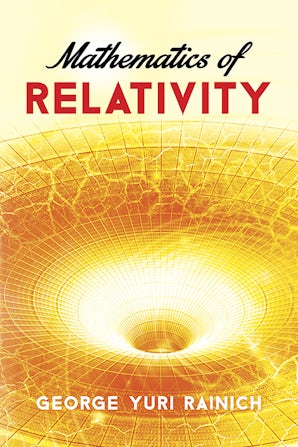
Mathematics of Relativity
Based on the ideas of Einstein and Minkowski, this concise treatment is derived from the author's many years of teaching the mathematics of relativity at the University of Michigan. Geared toward advanced undergraduates and graduate students of physics, the text covers old physics, new geometry, special relativity, curved space, and general relativity.
Beginning with a discussion of the inverse square law in terms of simple calculus, the treatment gradually introduces increasingly complicated situations and more sophisticated mathematical tools. Changes in fundamental concepts, which characterize relativity theory, and the refinements of mathematical technique are incorporated as necessary. The presentation thus offers an easier approach without sacrifice of rigor.
Beginning with a discussion of the inverse square law in terms of simple calculus, the treatment gradually introduces increasingly complicated situations and more sophisticated mathematical tools. Changes in fundamental concepts, which characterize relativity theory, and the refinements of mathematical technique are incorporated as necessary. The presentation thus offers an easier approach without sacrifice of rigor.
Reprint of the John Wiley & Sons, New York, 1950 edition.
physics;history of science;inverse square law;vectors;maxwells equations;equations of motion;new geometry;special relativity;curved space;riemann tensor;motion of a planet;science and math;theory of relativity;advance undergraduate;university level;simple calculus;analytic geometry;fundamental concepts;mathematical tools;einstein;minkowski;general relativity$4.48
Original: $14.95
-70%Mathematics of Relativity—
$14.95
$4.48Product Information
Product Information
Shipping & Returns
Shipping & Returns
Description
Based on the ideas of Einstein and Minkowski, this concise treatment is derived from the author's many years of teaching the mathematics of relativity at the University of Michigan. Geared toward advanced undergraduates and graduate students of physics, the text covers old physics, new geometry, special relativity, curved space, and general relativity.
Beginning with a discussion of the inverse square law in terms of simple calculus, the treatment gradually introduces increasingly complicated situations and more sophisticated mathematical tools. Changes in fundamental concepts, which characterize relativity theory, and the refinements of mathematical technique are incorporated as necessary. The presentation thus offers an easier approach without sacrifice of rigor.
Beginning with a discussion of the inverse square law in terms of simple calculus, the treatment gradually introduces increasingly complicated situations and more sophisticated mathematical tools. Changes in fundamental concepts, which characterize relativity theory, and the refinements of mathematical technique are incorporated as necessary. The presentation thus offers an easier approach without sacrifice of rigor.
Reprint of the John Wiley & Sons, New York, 1950 edition.
physics;history of science;inverse square law;vectors;maxwells equations;equations of motion;new geometry;special relativity;curved space;riemann tensor;motion of a planet;science and math;theory of relativity;advance undergraduate;university level;simple calculus;analytic geometry;fundamental concepts;mathematical tools;einstein;minkowski;general relativity